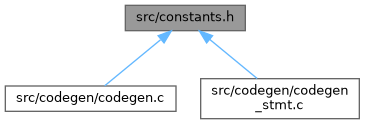
Go to the source code of this file.
Macros | |
| #define | MAX_TYPE_NAME_LEN 256 |
| Max length for type name strings. | |
| #define | MAX_FUNC_NAME_LEN 512 |
| Max length for function names. | |
| #define | MAX_ERROR_MSG_LEN 1024 |
| Max length for error messages. | |
| #define | MAX_MANGLED_NAME_LEN 512 |
| Max length for mangled names (generics). | |
| #define | MAX_PATH_LEN 4096 |
| Max length for file paths. | |
| #define | IS_INT_TYPE(t) ((t) && strcmp((t), "int") == 0) |
| Checks if type is "int". | |
| #define | IS_BOOL_TYPE(t) ((t) && strcmp((t), "bool") == 0) |
| Checks if type is "bool". | |
| #define | IS_CHAR_TYPE(t) ((t) && strcmp((t), "char") == 0) |
| Checks if type is "char". | |
| #define | IS_VOID_TYPE(t) ((t) && strcmp((t), "void") == 0) |
| Checks if type is "void". | |
| #define | IS_FLOAT_TYPE(t) ((t) && strcmp((t), "float") == 0) |
| Checks if type is "float". | |
| #define | IS_DOUBLE_TYPE(t) ((t) && strcmp((t), "double") == 0) |
| Checks if type is "double". | |
| #define | IS_USIZE_TYPE(t) |
| Checks if type is "usize" or "size_t"./*#end#*/. | |
| #define | IS_STRING_TYPE(t) |
| Checks if type is a string type ("string", "char*", "const char*"). | |
| #define | IS_BASIC_TYPE(t) |
| Checks if type is a basic primitive type. | |
| #define | IS_NUMERIC_TYPE(t) ((t) && (IS_INT_TYPE(t) || IS_FLOAT_TYPE(t) || IS_DOUBLE_TYPE(t) || IS_USIZE_TYPE(t))) |
| Checks if type is numeric (int, float, double, usize). | |
| #define | IS_PTR_TYPE(t) ((t) && strchr((t), '*') != NULL) |
| Checks if type string contains '*'. | |
| #define | IS_STRUCT_PREFIX(t) ((t) && strncmp((t), "struct ", 7) == 0) |
| Checks if type starts with "struct "./*#end#*/. | |
| #define | STRIP_STRUCT_PREFIX(t) (IS_STRUCT_PREFIX(t) ? ((t) + 7) : (t)) |
| Returns ptr to name after "struct " prefix./*#end#*/. | |
| #define | IS_OPTION_TYPE(t) ((t) && strncmp((t), "Option_", 7) == 0) |
| Checks if type is Option<T>. | |
| #define | IS_RESULT_TYPE(t) ((t) && strncmp((t), "Result_", 7) == 0) |
| Checks if type is Result<T>. | |
| #define | IS_VEC_TYPE(t) ((t) && strncmp((t), "Vec_", 4) == 0) |
| Checks if type is Vec<T>. | |
| #define | IS_SLICE_TYPE(t) ((t) && strncmp((t), "Slice_", 6) == 0) |
| Checks if type is Slice<T>. | |
Macro Definition Documentation
◆ IS_BASIC_TYPE
| #define IS_BASIC_TYPE | ( | t | ) |
Checks if type is a basic primitive type.
◆ IS_BOOL_TYPE
| #define IS_BOOL_TYPE | ( | t | ) | ((t) && strcmp((t), "bool") == 0) |
Checks if type is "bool".
◆ IS_CHAR_TYPE
| #define IS_CHAR_TYPE | ( | t | ) | ((t) && strcmp((t), "char") == 0) |
Checks if type is "char".
◆ IS_DOUBLE_TYPE
| #define IS_DOUBLE_TYPE | ( | t | ) | ((t) && strcmp((t), "double") == 0) |
Checks if type is "double".
◆ IS_FLOAT_TYPE
| #define IS_FLOAT_TYPE | ( | t | ) | ((t) && strcmp((t), "float") == 0) |
Checks if type is "float".
◆ IS_INT_TYPE
| #define IS_INT_TYPE | ( | t | ) | ((t) && strcmp((t), "int") == 0) |
Checks if type is "int".
◆ IS_NUMERIC_TYPE
| #define IS_NUMERIC_TYPE | ( | t | ) | ((t) && (IS_INT_TYPE(t) || IS_FLOAT_TYPE(t) || IS_DOUBLE_TYPE(t) || IS_USIZE_TYPE(t))) |
Checks if type is numeric (int, float, double, usize).
◆ IS_OPTION_TYPE
| #define IS_OPTION_TYPE | ( | t | ) | ((t) && strncmp((t), "Option_", 7) == 0) |
Checks if type is Option<T>.
◆ IS_PTR_TYPE
| #define IS_PTR_TYPE | ( | t | ) | ((t) && strchr((t), '*') != NULL) |
Checks if type string contains '*'.
◆ IS_RESULT_TYPE
| #define IS_RESULT_TYPE | ( | t | ) | ((t) && strncmp((t), "Result_", 7) == 0) |
Checks if type is Result<T>.
◆ IS_SLICE_TYPE
| #define IS_SLICE_TYPE | ( | t | ) | ((t) && strncmp((t), "Slice_", 6) == 0) |
Checks if type is Slice<T>.
◆ IS_STRING_TYPE
| #define IS_STRING_TYPE | ( | t | ) |
Checks if type is a string type ("string", "char*", "const char*").
◆ IS_STRUCT_PREFIX
| #define IS_STRUCT_PREFIX | ( | t | ) | ((t) && strncmp((t), "struct ", 7) == 0) |
Checks if type starts with "struct "./*#end#*/.
◆ IS_USIZE_TYPE
| #define IS_USIZE_TYPE | ( | t | ) |
Checks if type is "usize" or "size_t"./*#end#*/.
◆ IS_VEC_TYPE
| #define IS_VEC_TYPE | ( | t | ) | ((t) && strncmp((t), "Vec_", 4) == 0) |
Checks if type is Vec<T>.
◆ IS_VOID_TYPE
| #define IS_VOID_TYPE | ( | t | ) | ((t) && strcmp((t), "void") == 0) |
Checks if type is "void".
◆ MAX_ERROR_MSG_LEN
| #define MAX_ERROR_MSG_LEN 1024 |
Max length for error messages.
◆ MAX_FUNC_NAME_LEN
| #define MAX_FUNC_NAME_LEN 512 |
Max length for function names.
◆ MAX_MANGLED_NAME_LEN
| #define MAX_MANGLED_NAME_LEN 512 |
Max length for mangled names (generics).
◆ MAX_PATH_LEN
| #define MAX_PATH_LEN 4096 |
Max length for file paths.
◆ MAX_TYPE_NAME_LEN
| #define MAX_TYPE_NAME_LEN 256 |
Max length for type name strings.
◆ STRIP_STRUCT_PREFIX
| #define STRIP_STRUCT_PREFIX | ( | t | ) | (IS_STRUCT_PREFIX(t) ? ((t) + 7) : (t)) |
Returns ptr to name after "struct " prefix./*#end#*/.